
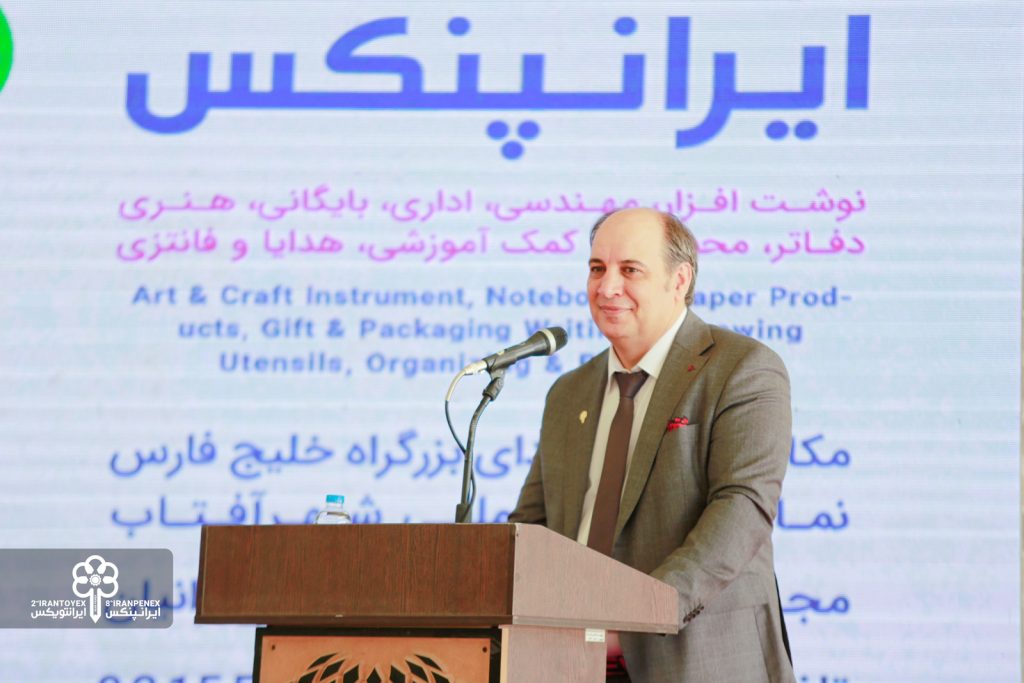
Majid Akbari, Executive Director of the 11th Iranpenex Stationery Exhibition and the 5th Irantoyex Toy Exhibition, told reporters on the sidelines of the events that approximately 150 companies are participating in the exhibitions. Of these, around 25 are importers, while some companies are active in both production and imports. However, the majority of participants are domestic manufacturers.
Akbari described the event as the largest gathering of the country’s stationery and toy industries and said: “Considering the closure of schools last year, we hope that this year, coinciding with the reopening of schools, the exhibition will play an effective role in boosting the market and supporting domestic manufacturers.”
“Positive 168” Campaign and the Planting of 168 Saplings in Memory of Martyred Children
Referring to the cultural programs planned for this year’s exhibition, the exhibition’s executive director said: “This year, in a dedicated area called ‘Narenjestan,’ 168 saplings have been symbolically planted in memory of martyred children. The ‘Positive 168’ campaign has also been launched with the donation of 168 backpacks. All participants can contribute backpacks to increase this number before the beginning of the new school year, with the aim of distributing them to underprivileged students across the country.”
He added: “The exhibition’s art section, titled ‘ArtMax,’ is also being held for the fourth consecutive year, providing artists with an opportunity to present their works in interaction with the stationery and toy industries.”
“We Stay Together, We Build the Future” — This Year’s Exhibition Slogan
Akbari explained that the products presented at the event are offered across seven to eight major product categories, including stationery, office equipment, filing and archiving products, engineering supplies, fantasy products, notebooks, and promotional gifts. He added that efforts have been made to utilize the full potential of the industry.
Referring to this year’s exhibition slogan, he said: “The slogan of this edition is ‘We Stay Together, We Build the Future,’ and we believe that the future of our country will be built through solidarity and cooperation among all those active in this industry.”
Foreign Brands at the Exhibition Operate Under Representation or Licensing Agreements
Regarding the presence of foreign brands, the exhibition’s executive director clarified: “No foreign company is participating directly in the exhibition. The brands present are either operating under license or represented by official agents in Iran.”
Responding to criticism regarding the availability of foreign products at the exhibition, Akbari said: “Such criticism is not based on expert analysis, because not all stationery products are currently manufactured domestically. Products such as staplers, staples, and certain other items are still not produced locally. In addition, limitations in raw materials and economic challenges have made 100-percent domestic production impossible in all segments.”
He emphasized: “Our goal is to create a healthy competitive environment, prevent monopolies, and provide consumers with a diverse range of choices. Just as in other countries, where product diversity reflects domestic production capabilities, Iran should also make use of domestic production capacity alongside targeted imports.”
Domestic Production Can Meet 70% of the Market, with Strong Export Potential
Regarding the share of domestic production in the stationery market, Akbari stated: “Under current conditions, domestic production capacity can meet approximately 70 percent of the market. If conditions for supplying raw materials improve, the import of necessary materials is facilitated, and the required infrastructure is provided, this capacity can increase.”
He also referred to the export potential of Iran’s stationery and toy industries, saying: “Iran has the capacity to export to regional countries and even some European markets. However, realizing this potential requires the establishment of appropriate economic infrastructure, the facilitation of trade exchanges, and the ability to repatriate export revenues.”
Source: PANA


